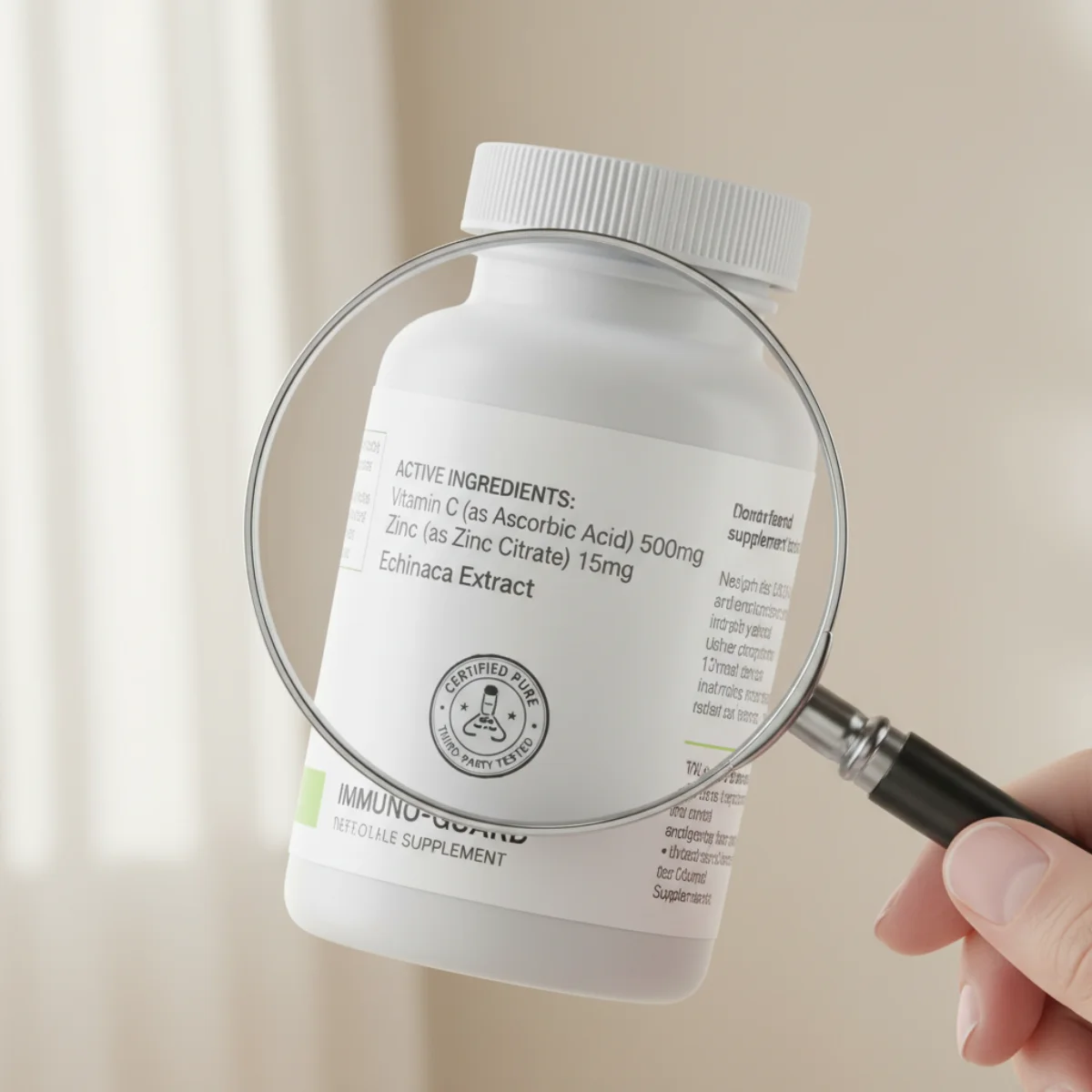
Supplement labels contain critical information about what you're buying, but they're often dense, technical, and harder to interpret than food or drug labels. Unlike pharmaceuticals, dietary supplements in the United States face less rigorous FDA oversight, which means reading the label yourself is your first line of defense against misleading claims, incorrect dosages, and potential contaminants. This guide walks you through every section of a supplement label so you can make informed choices and avoid costly or unsafe mistakes.
Understanding the Supplement Facts Panel
The Supplement Facts panel is the label's core information box, similar in layout to a food Nutrition Facts panel but formatted specifically for dietary supplements. It lists the serving size at the top, followed by a list of active ingredients with their amounts per serving, usually expressed in grams (g), milligrams (mg), or micrograms (mcg).
The first thing to check is serving size. This number tells you how many pills, capsules, grams, or milliliters constitute one serving. Many supplements require multiple servings per day to reach the effective dose discussed in research. If a label says "Serving Size: 2 capsules" but you take 3 capsules daily, you're consuming 1.5 servings, which means you need to multiply all listed amounts by 1.5 to understand your actual intake. This is where many people unwittingly underdose or overdose.
Below serving size, you'll see the list of active ingredients and their amounts. Some ingredients will also show a % Daily Value (%DV), which represents how much of the recommended daily intake that ingredient provides. For vitamins and minerals with established Daily Values (like vitamin C or calcium), a higher %DV isn't always better—your needs depend on age, sex, and health status. For other ingredients like herbal extracts or amino acids, no %DV exists because no official recommendation has been set; in these cases, the panel simply lists the amount.
Decoding Ingredient Lists and Amounts
The ingredient list appears in descending order by weight, meaning the first ingredients make up the largest portion of the product. However, this can be misleading when ingredients are listed under a proprietary blend.
A proprietary blend is a combination of ingredients listed under a single name with a single total weight. The formula appears only once, and the individual amounts of each component are not disclosed. For example, a "Herbal Energy Blend (500 mg)" might contain caffeine, ginseng, and rhodiola, but you won't know whether the 500 mg is split evenly or whether one ingredient dominates. This lack of transparency makes it impossible to compare with competitors or adjust your dose based on research. When possible, choose products with fully disclosed amounts for each ingredient.
Pay attention to ingredient form and source. Some labels specify whether an extract is standardized (meaning it's been concentrated to a specific potency level) or a whole-food powder. Standardized extracts are typically more potent and consistent than powders. For example, a label might say "Ginseng Root Extract (standardized to 4% ginsenosides)" rather than just "Ginseng Powder." The standardization tells you the product's active-compound concentration. When comparing similar supplements, ask yourself whether one form is more clinically relevant based on the research you've read or discussed with a clinician.
Identifying Third-Party Testing and Seals
Because supplement manufacturers are responsible for testing their own products (unlike drug makers), third-party testing is a significant quality marker. Look for seals or statements indicating that an independent lab has verified the product's contents and checked for contaminants.
The most widely recognized seals include:
- USP (United States Pharmacopeia)—verifies that the product contains the labeled ingredients in the claimed amounts and is free of harmful contaminants.
- NSF Certified for Sport—tests for banned substances and is especially relevant if you're an athlete.
- ConsumerLab—independently tests supplements and publishes results online; you can verify a product's test date and results on their website.
- Informed Choice—certifies that a product is free of banned substances, popular in the sports nutrition space.
These seals cost manufacturers money, so not all quality products have them—but if they're present, it's a strong signal. Be wary of vague claims like "lab tested" or "quality assured" without a recognized third-party name; these statements are unverified marketing language.
Understanding Allergen Statements and Inactive Ingredients
The label must disclose if a product contains common allergens (milk, eggs, fish, shellfish, tree nuts, peanuts, wheat, and soy) or if it was manufactured in a facility that handles these allergens. Even if the allergen isn't an active ingredient, cross-contamination during manufacturing is possible, so if you have a severe allergy, this warning matters.
The inactive ingredients list includes binders, fillers, flow agents, and flavorings that make the supplement suitable for consumption but don't contribute to its therapeutic effect. Common inactive ingredients include microcrystalline cellulose (a thickener), magnesium stearate (a lubricant), and silicon dioxide (an anti-caking agent). For most people, these are harmless in the small amounts used. However, if you have sensitivities to excipients (inactive components), check this list carefully. Some people react to certain binders or fillers; understanding what you're taking helps you troubleshoot if side effects occur.
Evaluating Dosage Recommendations and Usage Instructions
The label's Directions or Usage section tells you how much to take and how often. This is the manufacturer's recommended dose, though it may not match the dose used in clinical studies. Research your supplement before purchasing so you can compare the labeled recommendation with evidence-based dosing. If the label suggests a much lower or higher dose than the published literature supports, consider whether you trust the manufacturer's formulation decisions.
Check whether the recommended dose can be taken all at once or should be split throughout the day. Fat-soluble vitamins (A, D, E, K) are often taken with food to improve absorption, while water-soluble vitamins like B-complex may be taken anytime. Some supplements work better on an empty stomach; others cause nausea if not taken with food. The label should guide you on this. When looking for a new supplement as part of your overall regimen, consult our supplement buying guide to understand how to integrate it safely with what you're already taking.
Spotting Red Flags and Marketing Claims
Supplement labels are subject to advertising regulations, but enforcement is lax compared to drug labeling. Learn to spot common red flags:
Disease claims (e.g., "cures diabetes" or "treats depression") are illegal on supplement labels. If a label makes these claims, it's fraudulent. Legal alternatives include "supports healthy blood sugar" or "may help mood." Be skeptical of any product claiming to treat or cure a disease.
Vague or exaggerated language like "supports wellness" or "promotes vitality" is common but meaningless. Compare this with more specific claims backed by research, such as "clinically shown to improve sleep quality in adults with occasional sleeplessness."
"Proprietary formulas" with unknown ingredient ratios are harder to evaluate. Transparent brands list each ingredient's amount clearly.
Inflated ingredient lists with dozens of active ingredients in a small serving size often signal low potency per ingredient. If 30 different botanicals are crammed into 2 capsules, each is likely present in a dose too small to be effective.
Missing storage instructions or expiration dates are concerning. Some supplements (especially oils and botanical extracts) degrade if stored incorrectly, so a label should specify whether to refrigerate, keep away from sunlight, or store in a cool, dry place.
What to Look for in Manufacturing and GMP Compliance
Look for a statement indicating that the product was manufactured in a facility following Good Manufacturing Practices (GMP). While GMP compliance is required by the FDA for supplement manufacturers, not all companies are equally rigorous. Third-party certifications (like those from USP or NSF) go beyond basic GMP by conducting independent testing.
The label should include the manufacturer's name and address. If you have questions about how the product was made or want to verify testing, you can contact them directly. Reputable companies are transparent about their manufacturing process and quality assurance. If a label provides little or no company information, that's a warning sign.
Comparing Labels and Making Your Final Choice
Once you understand how to read a label, comparing products becomes straightforward. Create a simple spreadsheet with the active ingredients, amounts per serving, serving size, and cost per serving. Calculate your total daily dose by multiplying the per-serving amount by the number of servings you'll take daily. Then compare this to relevant research to see which product aligns best with evidence-based dosing.
Price alone is never a good guide—a cheaper supplement may use lower-quality ingredients, proprietary blends that hide true potency, or no third-party testing. A higher price isn't a guarantee of quality either. Focus on transparency, third-party verification, and ingredient clarity. If two products contain the same active ingredients in the same amounts and one costs less, it's likely the better value. If they differ significantly, the more expensive one should justify its cost with superior form (e.g., standardized extract vs. powder), better absorption, or quality assurance.
When to Ask Your Healthcare Provider About a Label
Before starting a new supplement, especially if you take medications or have underlying health conditions, show your healthcare provider the label. They can review the ingredients, check for interactions with your medications, and confirm that the dose aligns with your individual needs. Some ingredients that are safe for most people may be contraindicated for you based on your medical history. A clinician can also help you interpret the evidence behind a supplement and advise whether it's worth trying.