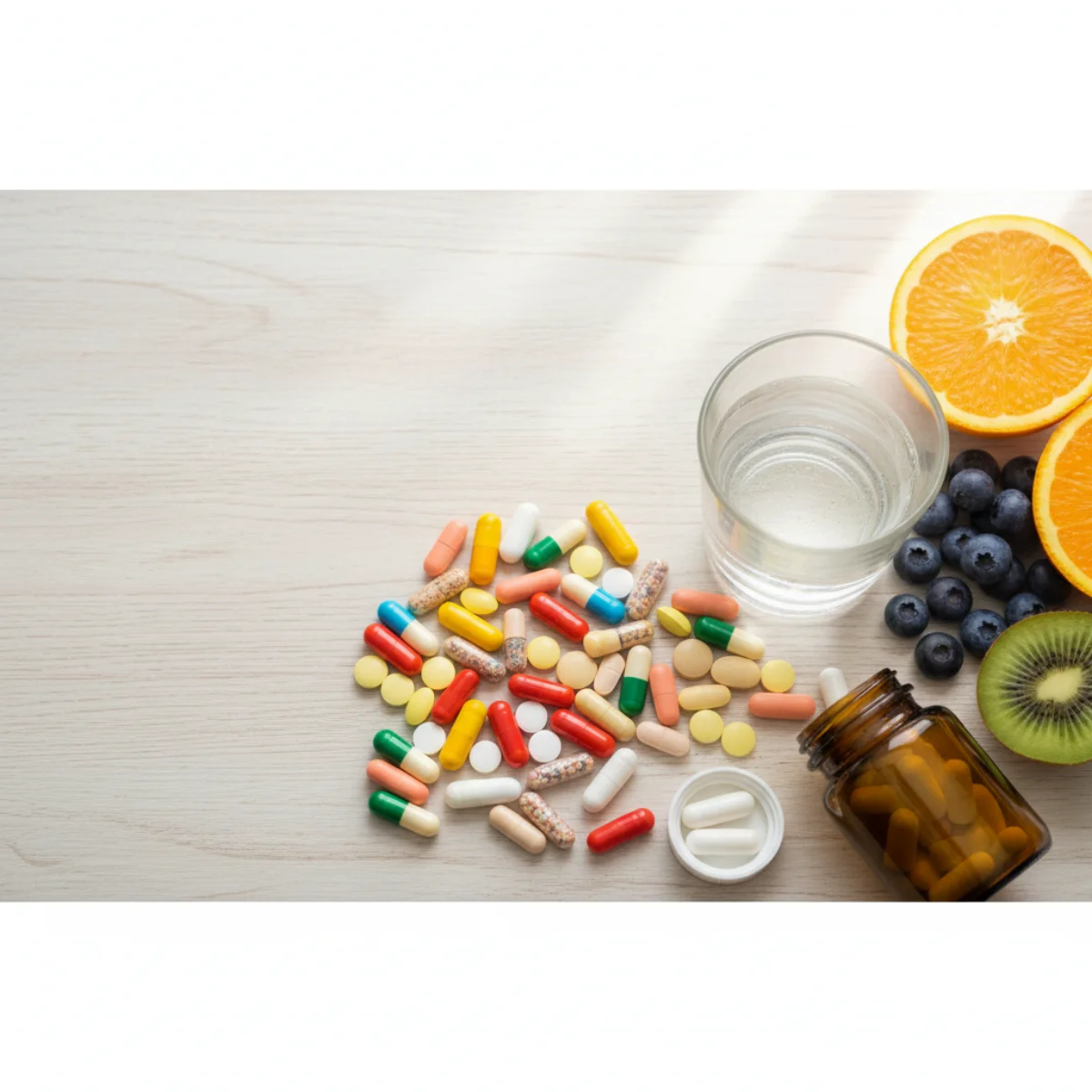
When you take a supplement, you might assume your body absorbs and uses most of what's in the capsule or tablet. In reality, bioavailability—the percentage of a nutrient that your body can actually absorb and make available for use—varies dramatically depending on the form, timing, food intake, and your individual physiology. A supplement that looks impressive on paper may deliver far less benefit if your body can't efficiently process it. Understanding bioavailability helps you choose supplements that will actually work and avoid wasting money on poorly absorbed products.
What Bioavailability Means
Bioavailability is a pharmacokinetic term that describes what fraction of an administered dose of a nutrient reaches systemic circulation in an active form capable of producing a biological effect. For oral supplements, it's the percentage of the ingested nutrient that successfully crosses the intestinal barrier, avoids metabolism in the liver, and becomes available to your cells and tissues.
If a supplement has 50% bioavailability, it means your body can utilize only half of what you ingest; the other half passes through your digestive system unused or is broken down before absorption. This is why two people taking identical supplement doses may experience different outcomes—and why a 500 mg dose of one form might deliver more usable nutrient than a 1000 mg dose of another.
Bioavailability differs from efficacy (whether a supplement produces the desired effect) and potency (the concentration of active ingredient). A supplement can be highly potent but poorly bioavailable, or moderately dosed yet efficiently absorbed. Real-world benefit depends on all three.
How Nutrients Are Absorbed
Your digestive tract is highly selective about what it absorbs. Unlike water, which passes through easily, minerals and some vitamins must either dissolve in stomach acid or attach to specific transport proteins to cross the intestinal epithelium. Factors at multiple steps of this process determine bioavailability.
Dissolution: Before absorption can occur, a supplement must dissolve. Tablets with poor disintegration may pass through your system intact. This is why pharmaceutical standards specify dissolution tests—a supplement must break down within a set timeframe in simulated gastric fluid.
pH and stomach environment: Stomach acid helps dissolve many minerals and breaks down certain compounds. Supplements taken with food or antacids experience different pH conditions, affecting dissolution and absorption rates. For example, iron absorption is enhanced in acidic conditions but inhibited if stomach pH is elevated.
Intestinal transport: The small intestine is where most nutrient absorption occurs. Specific transporters actively carry certain nutrients across the intestinal wall. Calcium uses active transport mechanisms that can become saturated—taking excessive amounts at once reduces absorption efficiency compared to spreading doses throughout the day.
First-pass metabolism: Nutrients absorbed from the intestine enter the hepatic portal blood system and pass through the liver before entering general circulation. The liver can metabolize, conjugate, or modify some nutrients, reducing their bioavailability. This is why some compounds are administered sublingually or transdermally to bypass the liver.
Factors That Influence Bioavailability
Supplement bioavailability is not a fixed property—it's dynamic and influenced by multiple variables that you can often control.
Chemical form: This is one of the largest determinants. Minerals exist in various chemical states: salts, chelates, and amino acid complexes have different absorption rates. Magnesium glycinate is absorbed more efficiently than magnesium oxide because glycine facilitates intestinal transport. Zinc picolinate is better absorbed than zinc sulfate. Iron from ferrous fumarate is more bioavailable than ferric oxide. When evaluating supplements, always check the specific form listed on the label.
Food and meal composition: Fat-soluble vitamins (A, D, E, K) require dietary fat for efficient absorption. Taking vitamin D with a meal containing fat can double or triple absorption compared to taking it fasted. Conversely, minerals like iron and calcium compete for absorption and are better taken separately. Some compounds are absorbed better on an empty stomach, while others irritate the stomach lining unless taken with food.
Dose size and timing: Larger doses don't always mean better absorption. Many nutrients use active transport systems that become saturated; beyond a certain threshold, additional intake is passively absorbed at low efficiency. Splitting doses across the day often improves total absorption. Taking supplements consistently at the same time helps your digestive system adapt and optimize absorption.
Individual factors: Age, digestive health, medications, and genetic variations all affect bioavailability. Older adults often have lower stomach acid production, reducing mineral bioavailability. People with celiac disease, inflammatory bowel disease, or other malabsorption conditions have compromised intestinal function. Medications like proton pump inhibitors reduce stomach acid and impair absorption of minerals and certain vitamins. Genetic variations in nutrient transporters mean some people naturally absorb nutrients more efficiently than others.
Gut microbiota: Your intestinal bacteria influence bioavailability through fermentation of certain compounds and production of short-chain fatty acids that enhance absorption. A healthy, diverse microbiome typically supports better nutrient absorption. Conversely, dysbiosis can reduce bioavailability.
Interactions with other substances: Some compounds enhance absorption (vitamin C improves iron absorption), while others inhibit it (calcium reduces iron absorption; phytates bind minerals and reduce their bioavailability). Understanding these interactions helps you time supplements strategically. This is why an effective supplement buying guide emphasizes dosing protocols, not just product selection.
Bioavailability Across Different Supplement Forms
Supplements come in different delivery forms, and bioavailability varies substantially between them.
Standard powders and tablets: These are the most common and affordable. Bioavailability depends entirely on the chemical form of the nutrient and how well the tablet disintegrates. A poorly formulated tablet might have bioavailability as low as 20-30%.
Capsules: Capsules typically dissolve faster than tablets, allowing better access to the nutrient. Bioavailability is often 10-15% higher than equivalent tablets, though still dependent on the nutrient form inside.
Chelated minerals: Chelation bonds a mineral to an amino acid or other organic compound, protecting it from interference in the digestive tract and enhancing intestinal transport. Chelated forms generally show 40-60% higher bioavailability than salt forms. Examples include magnesium bisglycinate, zinc picolinate, and iron bis-glycinate. The tradeoff is higher cost.
Liposomal supplements: These encapsulate nutrients in phospholipid vesicles that mimic cell membranes, theoretically improving cellular uptake. Evidence for liposomal forms is promising but mixed—some studies show substantial bioavailability improvements, others show minimal difference from well-absorbed forms. They are significantly more expensive.
Liquid and sublingual formulations: Bypassing stomach and intestinal absorption, sublingual supplements absorb directly through oral mucous membranes into the bloodstream. This can dramatically increase bioavailability for certain compounds, but evidence for most nutrients is limited. B12 as methylcobalamin sublingually shows better absorption than oral cyanocobalamin in some populations.
Emulsified and nano formulations: Breaking nutrients into smaller particles increases surface area, potentially enhancing dissolution and absorption. Evidence is still emerging for most nano formulations.
How to Measure and Verify Bioavailability
Bioavailability is determined through pharmacokinetic studies that measure blood and tissue levels of a nutrient after supplementation, comparing them to an oral reference dose or intravenous standard. These studies are expensive and are most commonly conducted for pharmaceuticals; fewer exist for dietary supplements.
For consumers, reliable bioavailability information comes from: published peer-reviewed research on the specific supplement form (not just the nutrient), third-party testing certifications that verify dissolution and disintegration, and manufacturers who cite bioavailability studies in their product literature. Be cautious of marketing claims without cited evidence—phrases like "maximum absorption" or "superior bioavailability" are often unsupported.
When bioavailability data for a specific product form don't exist, look at comparative research on different forms of the same nutrient. For example, there's robust evidence that magnesium glycinate has higher bioavailability than magnesium oxide, so choosing the glycinate form over oxide is a reasonable decision even without data on that exact brand.
Practical Applications for Better Supplement Outcomes
Understanding bioavailability principles helps you optimize your supplement regimen. Choose the right form: If a specific nutrient matters to your health, select a form with demonstrated better bioavailability—usually chelated minerals or amino acid complexes rather than basic salts. Time it correctly: Fat-soluble vitamins (D, E, K, A) should be taken with a meal containing fat. Iron is better absorbed on an empty stomach but taken with vitamin C; if stomach upset occurs, take with a small amount of food (but not with coffee, tea, or calcium). Magnesium and zinc can be taken with or without food but are better tolerated with a light meal. Avoid antagonistic combinations: Don't take calcium and iron together, or calcium and magnesium in the same dose—they compete for absorption. Space them by 2+ hours.
Split larger doses: If taking more than 400-500 mg of magnesium, split it into two doses. Calcium absorption is most efficient at 500 mg or less per dose. Maintain consistency: Taking supplements at the same time each day allows your digestive system to adapt and optimize absorption. Support gut health: Bioavailability starts in the gut. Adequate fiber, hydration, and a diverse diet support a healthy microbiome and better nutrient absorption overall. Be aware of medications: Discuss supplements with your doctor if you take medications that affect stomach acid (like antacids or PPIs) or that interact with nutrients, as these may require adjusted timing or forms.
When Bioavailability Matters Most
For some nutrients and health goals, bioavailability is critical; for others, it's less consequential. Bioavailability matters most when: (1) you're supplementing to address a specific deficiency or health concern where dosing precision is important, (2) cost is a consideration and you want your money to deliver actual benefit, (3) you have absorption challenges due to age, digestive illness, or medications, (4) you're taking a nutrient at the upper end of recommended intakes and efficiency affects safety margins.
Bioavailability matters less when: (1) you're taking a nutrient with very robust evidence showing oral supplementation works regardless of form (like vitamin D3), (2) you're taking a nutrient where the body can store excess and draw on reserves (like fat-soluble vitamins), (3) cost is not a factor and you're willing to take higher doses to compensate for lower absorption.
Key Takeaway
Bioavailability is the missing piece many people overlook when choosing supplements. Two products with identical nutrient content on the label can deliver vastly different results based on chemical form, delivery mechanism, timing, and individual factors. By understanding bioavailability principles and selecting supplement forms with better absorption profiles, timing doses strategically, and supporting your digestive health, you can ensure that your supplement regimen delivers real benefits rather than expensive urine.