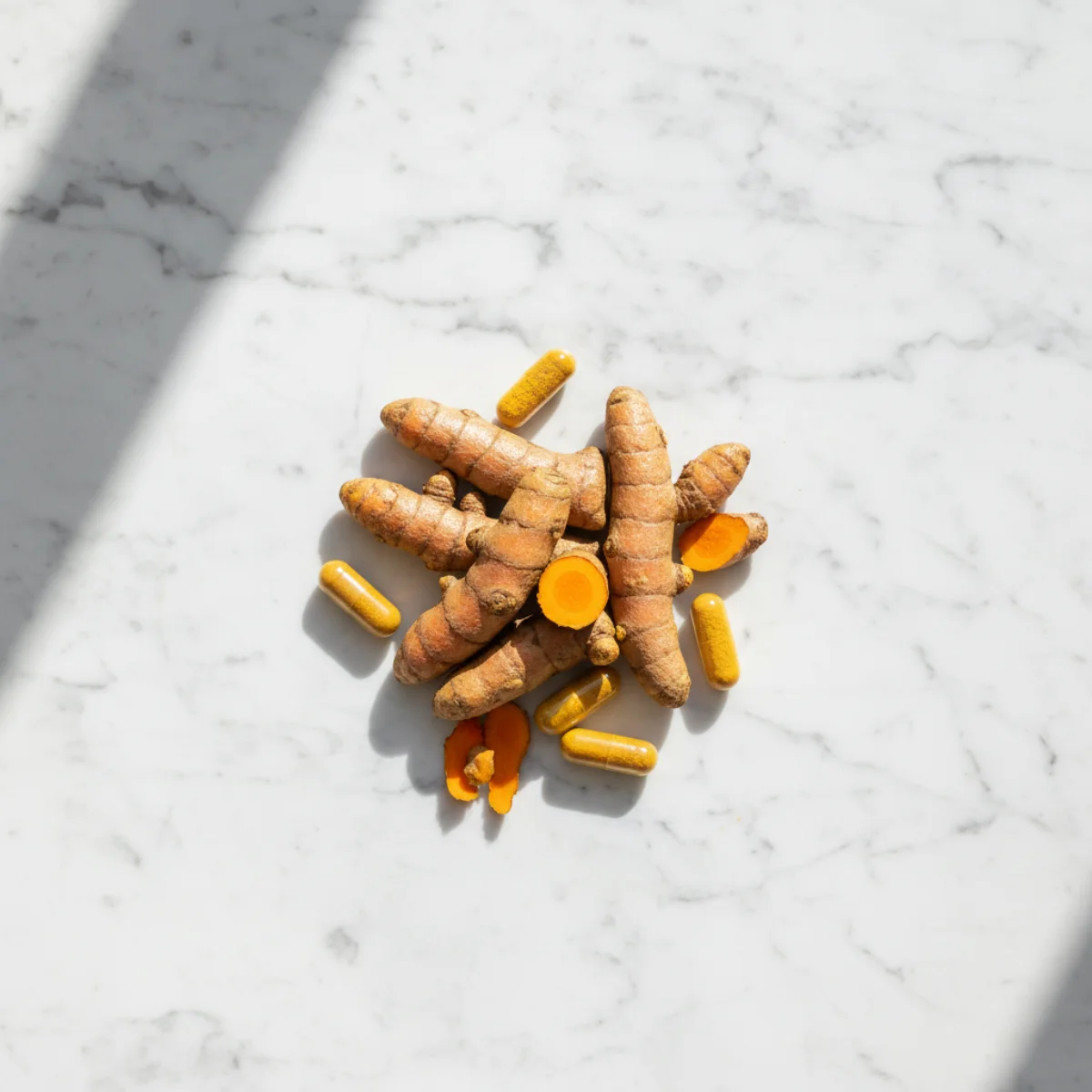
Plain curcumin, the active compound in turmeric, absorbs poorly—typically less than 1% reaches systemic circulation without enhancement. Meriva and Theracurmin are the two most researched bioavailable curcumin forms, each using distinct technology to solve this problem. Meriva pairs curcumin with soy phospholipids (forming a phytosome complex), while Theracurmin uses hydrophobic carrier systems and proprietary particle-size reduction. Both outperform standard curcumin, but they differ in absorption kinetics, pricing, and practical use. This guide compares the two across evidence, bioavailability, safety, and who benefits most from each.
What Each Is and How It Works
Meriva is a patented curcumin-phytosome complex developed by the company Indena. It binds curcumin to phosphatidylcholine (from soy lecithin), creating a lipid-soluble complex that mimics how dietary fats are absorbed through the intestinal lymphatic system. This phospholipid envelope enhances cellular uptake and reduces hepatic metabolism, extending the time curcumin circulates in the bloodstream.
Theracurmin (also called BCM-95) uses a different mechanism: curcuminoids are adsorbed onto a hydrophobic colloidal carrier system (Bioperine from black pepper extract, plus gum ghatti and lecithin). This formulation reduces particle size dramatically and may facilitate paracellular (between-cell) transport across the intestinal barrier. The result is rapid peak plasma levels, though some studies note lower overall area-under-the-curve (AUC) compared to Meriva.
Evidence by Outcome
Both formulations have been studied in humans, though total trial volume remains modest for curcumin overall. Curcumin-phytosome research (primarily Meriva) shows consistent benefits in joint comfort and inflammatory markers, with multiple 8–12 week RCTs demonstrating 20–40% improvements in pain and mobility scores. Theracurmin studies are fewer but include positive data on joint function and systemic inflammation (IL-6, CRP) in similar timeframes.
For digestive health, Meriva has stronger evidence: two RCTs in subjects with occasional bloating or digestive discomfort showed symptom improvement and improved intestinal permeability markers. Theracurmin data here is limited. Neither form has robust human evidence for cognitive, liver, or cardiovascular endpoints, though mechanistic studies are promising. Evidence for both remains preliminary in cancer-prevention contexts.
Bioavailability and Dose-Form
Bioavailability—the amount and speed at which curcumin reaches systemic circulation—is where these two diverge most visibly. Studies using identical dose amounts (e.g., 500 mg curcuminoids) show:
- Theracurmin: Higher peak plasma levels (Cmax) in 1–2 hours; reported as 27–40× better absorption than unformulated curcumin in acute studies. Peak levels are impressive, but decline more steeply over 24 hours.
- Meriva: Lower peak levels than Theracurmin but more sustained delivery over 6–8 hours. Overall systemic exposure (AUC) is comparable or sometimes superior to Theracurmin because Meriva curbs hepatic metabolism, prolonging half-life.
Practically: if you value rapid absorption and high short-term blood levels (e.g., targeting acute inflammation or post-workout), Theracurmin's faster spike may feel more effective. If you prefer consistent, steady-state dosing and fewer daily capsules, Meriva's sustained profile suits better. Both are available in capsule form; Meriva is also sold as a standalone powder.
Safety and Interactions
Both are exceptionally safe. Curcumin itself is non-toxic at high doses, and neither Meriva nor Theracurmin introduces novel safety signals. Reported side effects in trials are minimal and mild (occasional mild GI upset, headache <2% incidence). No serious adverse events have been documented at recommended doses.
Interactions: Curcumin is metabolized primarily by CYP3A4 and glucuronidation. At very high doses (>2–3 g/day), it may inhibit CYP3A4, theoretically affecting drugs like statins, certain immunosuppressants, or benzodiazepines. Neither Meriva nor Theracurmin changes this risk profile materially. If you take prescription medications metabolized by CYP3A4, discuss curcumin supplementation with your clinician. Both formulations include black pepper extract (piperine) or soy, which may matter for those with soy allergies (Meriva) or black pepper sensitivity.
Who Should Pick Which
Choose Meriva if:
- You want lower cost per dose and simpler, once-daily dosing.
- You prefer sustained curcumin levels throughout the day.
- You have occasional digestive discomfort or bloating (stronger evidence base).
- You're sensitive to soy and can confirm your supplement is soy-free (check the label).
- You prefer powdered options or dislike taking multiple capsules.
Choose Theracurmin if:
- You need rapid absorption and the highest acute plasma levels (e.g., around workouts or for acute inflammatory flares).
- Budget is secondary to bioavailability magnitude.
- You cannot tolerate soy or soy-derived products.
- You are sensitive to black pepper or piperine (Meriva is the safer choice here).
For most users with normal digestion, joint support, and general wellness goals, both work adequately. The choice is often practical (cost, capsule burden, local availability) rather than efficacy-driven.
Practical Buying Notes
Meriva dosing: Standard is 250–500 mg curcuminoids per dose, 1–2× daily with meals. Typical daily intake is 500–1000 mg curcuminoids.
Theracurmin dosing: Commonly 300 mg curcuminoids per dose, 1–3× daily. Higher bioavailability means lower total daily amounts often suffice; many users take 300–900 mg curcuminoids daily.
Cost comparison: Meriva-based supplements typically cost $10–18 for a month's supply. Theracurmin products range $25–40/month, reflecting patent status and research investment. If cost is a limiting factor, Meriva offers robust evidence at a lower price point.
Timing and food: Both should be taken with a fat-containing meal (curcumin is fat-soluble). Neither shows strong benefit from timing around workouts in human studies, though mechanistically rapid absorption (Theracurmin) could theoretically aid acute inflammation management.
Duration: Full benefits typically emerge over 4–12 weeks of consistent use. Curcumin accumulates in tissues over time, so patience is warranted before deciding a product isn't working.
How We Chose
This comparison draws on peer-reviewed bioavailability studies (head-to-head absorption comparisons), randomized controlled trials in joint health and inflammation, pharmacokinetic data, and safety reviews from clinical curcumin trials. We examined both products' published patents and independent third-party testing where available. The goal was to represent what evidence actually shows—including where it's limited—rather than marketing claims.