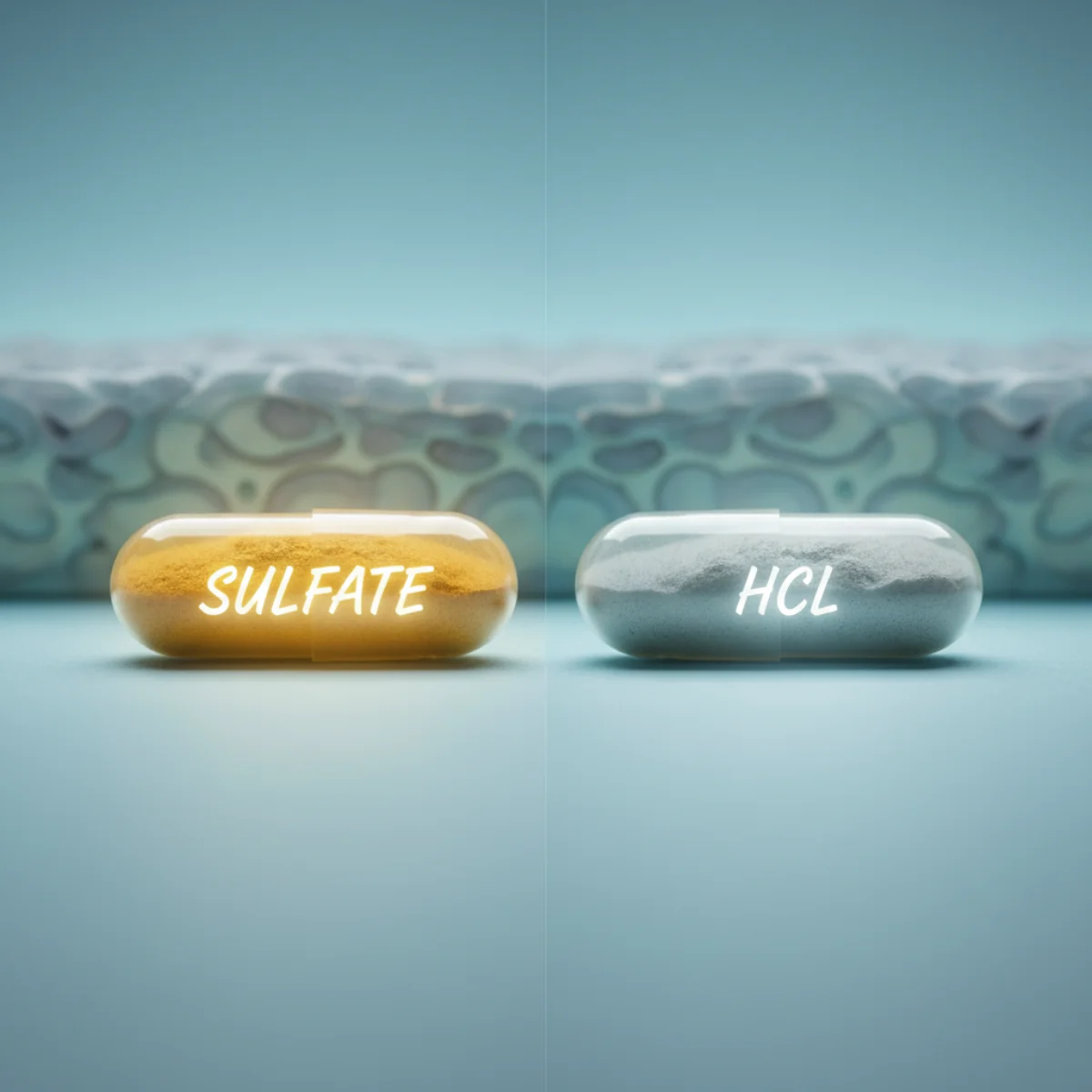
Glucosamine supplements come in two main chemical forms—sulfate and HCl—each with distinct absorption profiles, evidence bases, and practical trade-offs. Both provide the same amino sugar backbone that cells use to build and repair cartilage, but they differ in bioavailability, the inclusion of sulfur, and the strength of human clinical data supporting their use. This guide compares their mechanisms, evidence, dosing, safety, and practical buying considerations to help you choose the form most likely to work for you.
What Each Is and How It Works
Glucosamine sulfate is glucosamine chemically bonded to sulfate ions (SO₄²⁻). The sulfate moiety is not inert: sulfur is a key structural component of cartilage proteoglycans and chondroitin, and it participates in the synthesis of glycosaminoglycans (GAGs) that give cartilage its gel-like shock-absorbing properties. When you ingest glucosamine sulfate, your digestive system breaks the bond, and both the glucosamine and sulfate ions become available for absorption and tissue uptake.
Glucosamine HCl (hydrochloride) bonds glucosamine to hydrochloric acid instead. This is a simpler, more stable molecule. The HCl form dissociates readily in stomach acid, releasing free glucosamine quickly. The chloride ion has no known structural role in cartilage, so the bioactive component is the glucosamine alone. HCl is cheaper to produce and more shelf-stable than sulfate, which makes it attractive for manufacturers and consumers.
Both forms provide the foundational amino sugar that chondrocytes (cartilage-building cells) use in the synthesis of structural proteoglycans and collagen. The key biological question is whether the sulfate add-on in the sulfate form significantly enhances cartilage repair or whether the glucosamine backbone alone is sufficient. This difference is central to interpreting the clinical evidence.
Evidence by Outcome
The clinical picture favors glucosamine sulfate in head-to-head evidence. Large, multi-center randomized controlled trials—most notably the GAIT trial (2006) and subsequent meta-analyses—have shown that glucosamine sulfate at 1500 mg daily reduces joint pain and slows cartilage loss in knee osteoarthritis, particularly in participants with moderate-to-severe baseline symptoms. The effect size is modest (typically 20–30% improvement in pain scores over 6–24 months) but consistent and clinically relevant for many users.
Glucosamine HCl, by contrast, has weaker evidence. Multiple RCTs and a 2015 Cochrane review found that HCl does not outperform placebo in knee osteoarthritis. Some smaller studies suggest benefit, but the largest and best-designed trials show no meaningful effect. This discrepancy is attributed partly to the absence of sulfate and partly to lower bioavailability: HCl is absorbed rapidly but may not be retained in joint tissue as long as the sulfate form.
Both forms are studied for cartilage preservation and pain reduction; neither has robust evidence for reversing established damage or treating other joint conditions (hip, shoulder, spine). Evidence is strongest for knee osteoarthritis with 3–6 months of consistent use. Individual response varies widely; some users report significant relief, while others notice no change.
Bioavailability and Dose-Form
Bioavailability—the amount of active compound that enters the bloodstream and reaches target tissues—differs between the two.
Glucosamine sulfate is absorbed more slowly (peak plasma levels in 2–4 hours) but has a longer half-life in circulation (several hours). Notably, some sulfate remains intact and reaches cartilage tissue directly, where it may contribute to proteoglycan synthesis. The glucosamine component itself shows moderate intestinal absorption (roughly 10–20% of the oral dose), but the sulfate moiety enhances retention in connective tissues. Sulfate is typically supplied as a salt form paired with sodium or potassium to improve stability.
Glucosamine HCl absorbs rapidly (peak levels in 30–90 minutes) due to its simpler structure, but the rapid absorption means a shorter tissue residence time. Absorption efficiency is similar or slightly higher than sulfate in the gut, but less of the glucosamine is retained in cartilage. The rapid kinetics may mean less time for chondrocytes to incorporate the amino sugar into repair pathways.
Standard dosing reflects these differences. Glucosamine sulfate is typically dosed at 1500 mg once daily (some formulations split it into 500 mg three times daily). Glucosamine HCl dosing is usually 1500–2000 mg daily, often split into two or three doses, to maintain more constant serum levels. Some users find that the longer-acting sulfate form requires fewer daily doses, improving adherence.
Safety and Interactions
Both forms have excellent safety profiles in short- and medium-term use (up to 3 years studied). The most commonly reported side effects are mild and gastrointestinal: nausea, bloating, dyspepsia, and loose stools occur in 5–15% of users, similar to placebo rates in many trials. These typically resolve within a few weeks or can be managed by taking the supplement with food.
Allergic reactions are rare but possible, especially in people with shellfish or seafood allergy, because glucosamine is often extracted from shellfish (shrimp, crab) exoskeletons. Those with shellfish allergy should confirm that their supplement is either shellfish-free or labeled as safe for allergic individuals.
Drug interactions are uncommon for both forms. Neither significantly inhibits or induces cytochrome P450 enzymes. No major interactions with common medications (NSAIDs, blood thinners, diabetes drugs) have been documented. Some older concerns about glucosamine raising blood glucose in diabetics have not been borne out in clinical studies, though diabetics should monitor their blood sugar when starting any new supplement.
Long-term safety (beyond 3 years) is understudied. No organ toxicity has been reported, and animal studies do not show carcinogenic or developmental effects. However, people with severe renal impairment should consult a clinician before use, as there are few safety data in this population.
Who Should Pick Which
Choose glucosamine sulfate if:
- You have mild-to-moderate knee osteoarthritis pain and want the form with the strongest clinical evidence.
- You prefer once-daily dosing for convenience.
- You're willing to pay more for a form that may offer a small additional benefit from the sulfate moiety.
- You want the best-supported option for cartilage preservation over 6+ months of use.
Choose glucosamine HCl if:
- You're on a tight budget; HCl is typically 20–40% cheaper than sulfate.
- You prefer the simplicity of a single-ingredient, no-filler form.
- You have a rapid response to supplements and tolerate quick-absorbing compounds well.
- You want to try glucosamine without committing to the stronger-evidence (but more expensive) sulfate form first.
- You're interested in pairing it with another supplement like chondroitin or MSM to create a synergistic formula.
Realistically, individual response is the strongest driver of choice. Many users benefit meaningfully from either form; others benefit from neither. A 3-month trial is reasonable to assess personal efficacy. If you see no improvement by month 3 (or if pain actually worsens), switching to the other form or stopping is warranted.
Practical Buying Notes
Form and sourcing: Glucosamine sulfate is usually sold as a larger, slightly bulkier tablet (often combined with sodium or potassium). HCl is smaller and more compact. Both are widely available. Check the label to confirm the form;